Learn .NET in a real development environment.
Desktop app for learning C# and .NET 10. Full IntelliSense, a real debugger, and an AI tutor that actually reads your code.
Regular price: $59 Price now: $39, one-time Windows 10/11 7-day refund
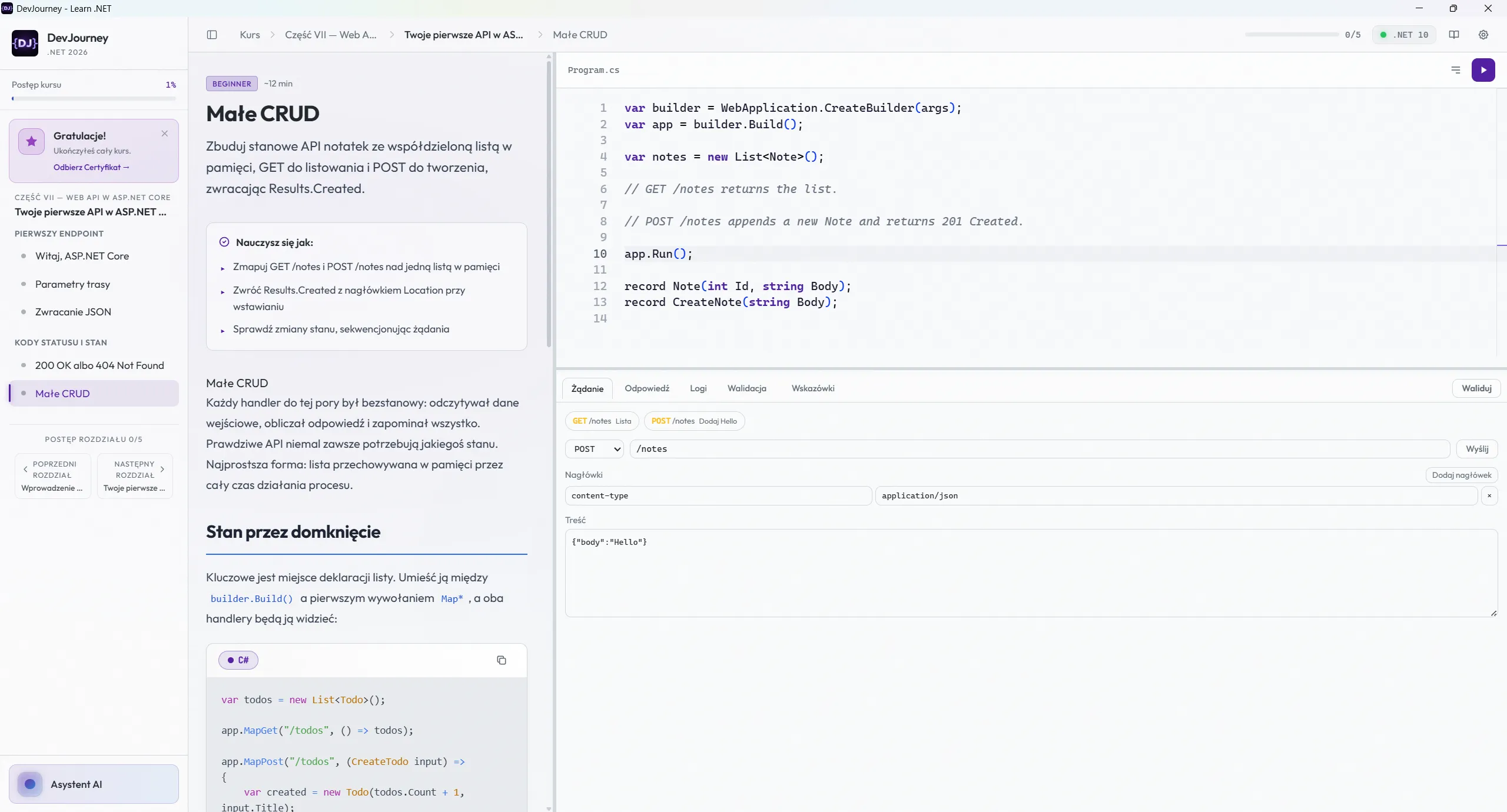
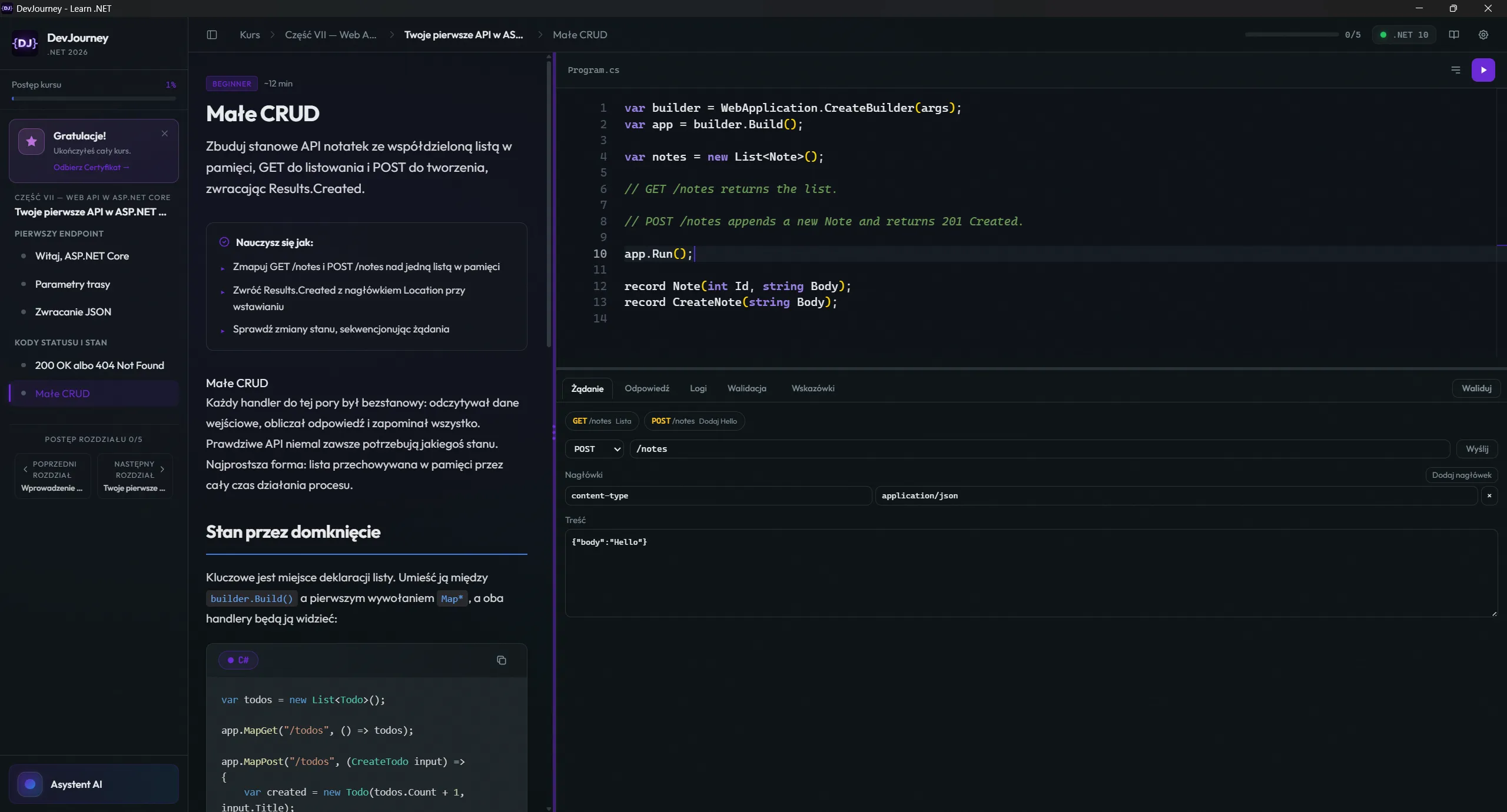
Pay once. It's yours forever.
One-time license, free 1.x updates, lessons and compiler work offline
Local tooling
Editor, debugger, and compiler: the tools you'll use at work.
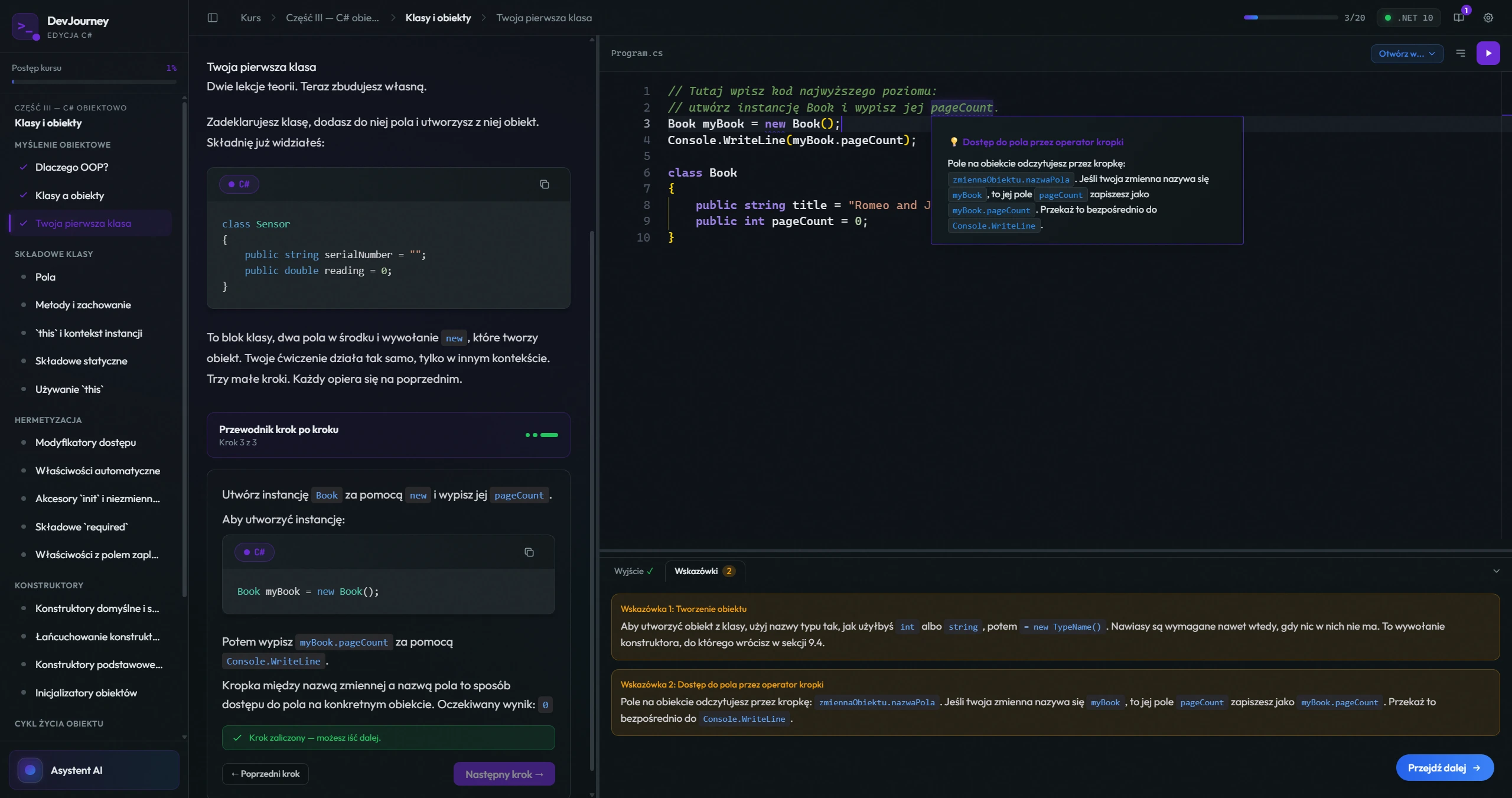
Microsoft's Roslyn, the C# engine behind Visual Studio and VS Code, plus your local .NET SDK. Errors show up as you type; Run compiles code on your machine.
Pick a feature
Hover the underlined code
AI tutor
Bring your own AI: free tier or paid, no extra cost.
DevJourney drives OpenAI's Codex CLI and Anthropic's Claude Code CLI, the same tools professionals use, locally as a subprocess that sees your code and your lesson. A paid plan is optional: the free tiers work too, with no markup on top.
Pick an integration
AI Assistant
☁ GPT-5.4 Mini
Send the question
Scratchpad
Try one line of C# without starting a project.
Open the scratchpad from the top bar, pick a starter and press Run. No dotnet new, no folder to name, no project file. It runs on the same Monaco editor, Roslyn diagnostics and local .NET SDK as the lessons, and notes are saved on your machine, so last week's experiment is still where you left it.
- Six starters Console, LINQ, async/await, xUnit, EF Core + SQLite and a Minimal API. Each one compiles and runs as it is.
- Notes stay put Saved locally in SQLite. Order them by last change or date created, and filter by name once there are too many to scan.
- Web notes run too A Minimal API note starts Kestrel and puts a request panel under the editor, so GET /ping never leaves the window.
No output yet.
Pick a starter, then press Run
670+ lessons. 60 chapters.
Nine parts walk you from Console.WriteLine through OOP, LINQ, async, testing, and EF Core to Web APIs, and end on a task-management app you build. It doesn't stop at syntax either: delegates and events, integration testing, performance, security, deployment, and application architecture each get a chapter of their own. A tenth part is a bonus interview-prep track. The whole course, over 670 lessons, is available in full in English and Polish.
- 01What Is Programming?
- 02Meet C# and .NET
- 03Your First Program
- 04Values, types, and variables
- 05Operators, strings, and expressions
- 06Control flow
- 07Methods
- 08Collections basics and error handling
- 09Project: Word Frequency CLI
- 10Classes and objects
- 11Inheritance and polymorphism
- 12Interfaces and abstract types
- 13Structs, records, and enums
- 14Project: Mini Library
- 15Generics
- 16Collections deep dive
- 17Delegates, lambdas, and events
- 18LINQ
- 19Project: Sales Report (LINQ)
- 20Asynchronous programming
- 21Project: Mini Pub/Sub
- 22Modern C# Features and Patterns
- 23Projects, Packages, and Tooling
- 24Files, Streams, and Serialization
- 25Application Building Blocks
- 26Unit Testing with xUnit
- 27Project: Markdown → HTML
- 28Project: TDD String Utils
- 29Database fundamentals
- 30EF Core Foundations
- 31Modeling data and migrations
- 32Advanced data access
- 33Saving, transactions, and performance
- 34Project: Forum Threads
- 35Introduction to Web Development
- 36Your first ASP.NET Core API
- 37Your First Web API
- 38Routing and Middleware
- 39Minimal APIs and Controllers
- 40Binding, Validation, and Content
- 41Consuming HTTP APIs
- 42Authentication
- 43Authorization
- 44Cross-Cutting Concerns
- 45Documentation, Versioning, and Real-Time
- 46Integration Testing
- 47Debugging and Performance
- 48Security Essentials
- 49Deployment and Operations
- 50Application Architecture
- 51Project: TaskTracker, production-ready
- 52TaskTracker
Project: TaskTracker
A web app for task management: ASP.NET Core Razor Pages + EF Core + SQLite, with an xUnit test suite. Multi-file editor, built-in HTTP client to test the endpoints.
- 53C# and .NET Recall
- 54OOP, SOLID, and Patterns
- 55Data Structures and Algorithms
- 56Async, Concurrency, and Performance
- 57Data, SQL, and the Web Stack
- 58Live Coding and System Design
- 59Project: The Take-Home API
- 60Project: The Refactoring Take-Home
PROGRAMMING & AI
Yes, it's still worth learning to code.
The question everyone's asking: if AI writes so much of the code, why learn it yourself? Because AI raised the value of understanding code; it didn't remove it. Five honest reasons:
Further reading: The 70% problem (Osmani) / How I use LLMs (Willison)
-
You can't review what you can't read
AI produces a plausible answer in seconds. Deciding whether it's correct, secure, and worth shipping is the job now, and that takes someone who reads code fluently.
-
When generated code breaks, understanding gets you out
Re-prompting a bad fix tends to add two new bugs. Reading a stack trace and stepping through a debugger is how you break out of the loop.
-
AI extends the programmer, it doesn't replace one
It multiplies the output of someone who knows what they're doing. It can't supply the judgment from nothing; experienced instincts are exactly what pull the best results out of it.
-
Fundamentals are the moat now
Once AI commoditizes the obvious code, your edge is what it's bad at: architecture, data modeling, performance, security, tradeoffs. That knowledge is worth more, not less.
-
Learn it yourself first, then let AI accelerate you
Let AI do your thinking while you learn and you end up with a black box you can't debug. Build the mental model by writing the code yourself, then hand the boring parts to the machine.
THE JOB MARKET
AI writes the code. Knowing whether it's any good is what gets paid.
Five ads of the kind that actually circulate, assembled from real requirement lines and published salary data. Open any of them to see what the work is day to day, and how much of it you already have after this course.
These are US figures from Built In's self-reported data, which leans toward funded tech companies in expensive metros, so read them as the upper half of the market rather than the middle. What holds everywhere: back-end work is the largest slice of the market, it pays above the general developer average, and the ads here are what it looks like from the inside.
- $144K
- median software developer base pay, US
- $183K
- median back-end developer base pay
- $155K
- median ML engineer base pay
Source: Built In, US tech salaries 2026. Self-reported base pay, equity excluded.
Example ads
Green: covered by the course. Grey: what the employer adds on top.
The companies in these ads don't exist, and the pay is a median from market reports, not a promise. That's also why there's no apply button: these are not openings.
The course doesn't hand you a job. It gives you what these ads ask for. The portfolio, the CV and the interviews are your half of the road, and you walk in with something concrete.
Editor and tooling
- Monaco editor — the same editor core VS Code runs on
- Roslyn IntelliSense — completions, hover docs, signature help, go-to-definition
- Compiler diagnostics as you type, with quick fixes and formatting
- Your own .NET SDK compiles the code — no sandbox, no cloud runner
- Step debugger — breakpoints, step into, step over, step out
- Locals, Watch and Call Stack panels, plus conditional breakpoints
- The debugger turns on in chapter 8 and stays available on 200+ lessons after it
- Open in IDE — VS Code, Visual Studio, Rider or Zed, in one click
AI tutor
- Codex CLI or Claude Code — driven locally, as a subprocess
- Runs on the plan you already have; the free tiers work, with no markup on top
- Reads the lesson, your file and the compiler error before it answers
- Explain, Debug and Hint buttons, plus a menu on any code you select
- Explains the mistake instead of pasting the answer
The course
- 670+ lessons across 60 chapters and 10 parts
- From Console.WriteLine to ASP.NET Core Web APIs, on .NET 10 and EF Core 10
- Exercises graded against real program output, not a checkbox
- Guided lessons that walk one step at a time
- Quizzes, concept lessons, visualizers and Mermaid diagrams
- A hint ladder — a nudge first, the solution last
- Glossary — hover a term for its definition; the app marks the ones you've met
- The whole course in English and Polish, switched inside the app
Real project work
- Project: TaskTracker — ASP.NET Core Razor Pages + EF Core + SQLite
- Multi-file project explorer, with snapshots you can restore
- xUnit suites where the tests passing is the grade
- Built-in HTTP client — call your own API without leaving the window
- Web lessons boot a real Kestrel server, with live logs
- dotnet ef migrations and dotnet watch, run from inside the app
- Scratchpad with six starters — console, LINQ, async, xUnit, EF Core, Minimal API
- Interview track — rapid-fire drilling plus two timed take-home projects
What you own
- One payment — no subscription, no seats, no renewal
- Free updates through the whole 1.x line
- 7 days to get your money back, no questions
- One machine, moved by you — deactivate here, activate there
- Lessons and NuGet packages ship inside the app — exercises compile with nothing to download
- The app works offline — the licence is checked periodically
- Completion certificate — a PDF with a hash anyone can verify
- Free demo — all of Part I, with nothing stripped out
The app
- Windows 10/11 desktop app that updates itself
- Keyboard shortcuts throughout, and a Ctrl+P file switcher in project work
- Light and dark themes, or follow the system
- Resizable panels — lesson, editor, output and AI, sized how you want them
- Progress kept in a local SQLite file on your own disk
One price. Everything included.
−33%
- 670+ lessons across 60 chapters
- Project: ASP.NET Core TaskTracker
- AI tutor via Claude Code / Codex CLI, on your existing plan
- Step debugger + HTTP client
- Activation on 1 machine
- Completion certificate (PDF + hash)